If you have ever stared at sixteen words and felt simultaneously certain and wrong, you already understand why word grouping games have quietly become the most talked-about puzzle format of the last few years. The genre owes its mainstream moment to a single daily puzzle, but the psychological machinery underneath it is much older, and much sneakier, than it looks.
What actually makes a grouping puzzle work
The mechanics are deceptively simple: here is a set of items, sort them into categories. Children do this in kindergarten. The reason adults find it genuinely difficult, sometimes maddening, comes down to one design principle that every good grouping puzzle exploits mercilessly: the intentional overlap trap.
A word grouping game is only interesting when a word could plausibly fit more than one category. PITCH belongs with music terms. It also belongs with baseball terms, sales terms, and things that are black. The puzzle designer chooses words that wear multiple hats, then bets you will grab the wrong hat first. You lock in your confident answer and burn a guess. That sting is the product of careful craft, not accident.
The second ingredient is category concealment. The label for a group is never shown to you upfront. You have to reverse-engineer it from the members you find. This matters because the human brain is extremely good at finding patterns when it knows what pattern to look for, and extremely fallible when it does not. A grouping puzzle keeps the frame hidden until you have already committed to a theory. That gap between theory and label is where the aha moment lives.
The overlap trap in practice
Think about how a single stubborn tile can paralyze you. You have cleared three groups cleanly. One word remains in the fourth and it makes no sense there. You go back and rethink a word from a group you already solved, wondering if you mis-sorted it. That doubt spiral is not a flaw in the format. It is the format doing exactly what it is supposed to do.
Good puzzle designers seed two or three of these traps deliberately. They pick a word that is an almost-perfect fit for a decoy category, place it in the actual correct category, and watch players chase the ghost. The moment you see through the trap is a small, clean pleasure. It feels like a lock clicking open.
How Looplink extends the genre
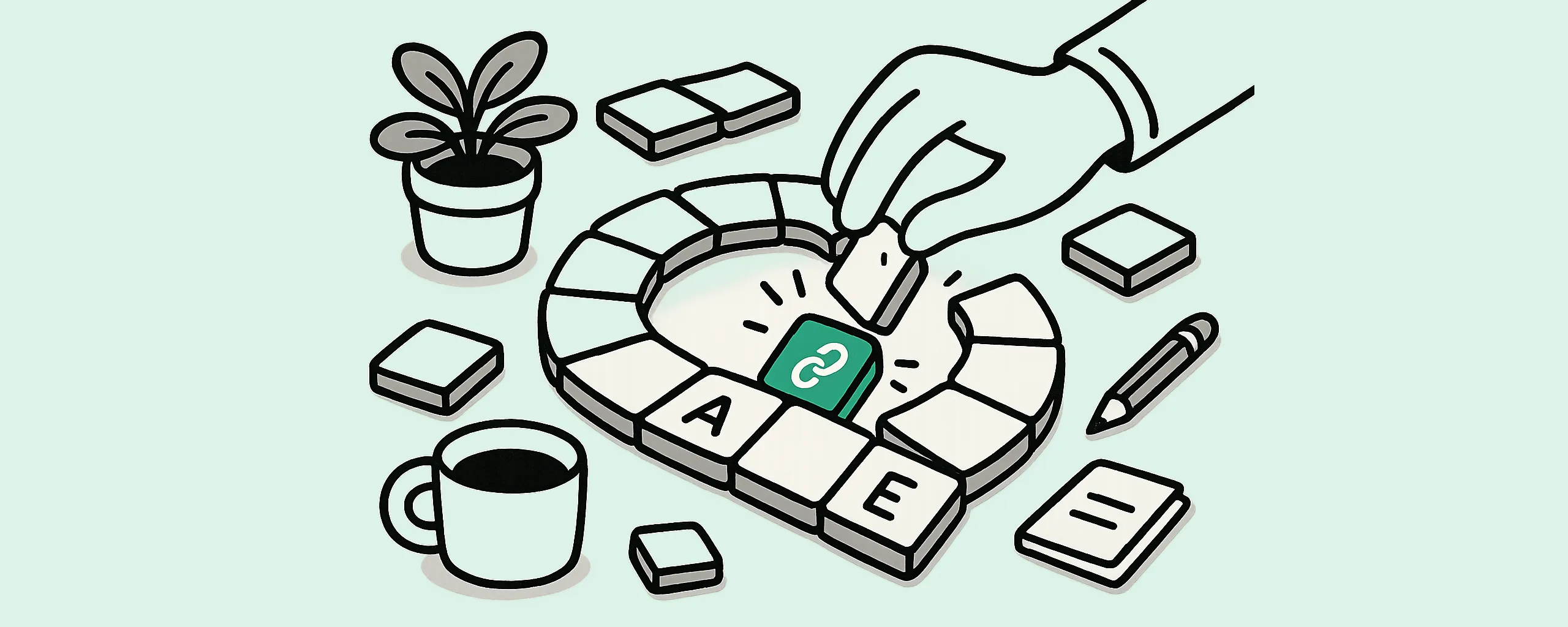
Looplink is Greatest Games' take on the connections format, and it adds one mechanical twist that changes the character of the puzzle entirely: link tiles. In Looplink, the groups do not just need to be sorted correctly. Adjacent groups share a tile that belongs, in some sense, to both. The connections between categories are not just conceptual. They are structural.
This matters for a few reasons. First, it raises the cost of a wrong guess. In a standard grouping puzzle, a mistake costs you an attempt and maybe some confidence. In Looplink, a misplaced link tile can knock two groups out of alignment at once, because the tile that bridges them is now sitting in the wrong place. The puzzle becomes a chain, not just a set.
Second, the link tile gives you a new tool. If you are stuck, you can sometimes reason backward from what a shared tile would have to mean to connect two groups. That is a different cognitive move than pure category matching. It asks you to think about relationships between groups, not just membership within them.
The result feels a little like a crossword crossed with a grouping puzzle. Your answers constrain each other. The satisfaction at the end is correspondingly larger, because you know you did not just get lucky on four independent choices.
Why the genre keeps people coming back daily
Daily puzzle games work because of the commitment device. One puzzle, once a day, no more. That constraint creates anticipation, and anticipation is more motivating than abundance. You cannot binge a daily puzzle. You can only return tomorrow.
Grouping puzzles specifically reward return visits because you accumulate what you might call trap literacy. The more puzzles you have played, the better you are at recognizing the decoy categories a designer might plant. You start to ask the right skeptical questions earlier. That slow accumulation of skill is one of the things that keeps a daily habit alive.
Everything at Greatest Games is built around that daily rhythm. All the games here are free, require no account or signup, serve one fresh puzzle per day, reset at midnight Eastern, and are designed to fit into about five minutes. Looplink fits that model exactly, and so does the rest of the library on the hub.
The grouping genre's place in the puzzle landscape
It is worth saying clearly: connections-style puzzles and word guessing games solve different problems. Something like Wordly rewards deductive narrowing, a process of elimination toward a single answer. A word grouping game rewards lateral thinking and controlled second-guessing. The two formats use language differently. Wordly asks you to probe the shape of a word. A grouping puzzle asks you to hold multiple meanings of a word in mind simultaneously and decide which one the designer intended.
That is why players who love one often love the other, but the skills do not fully transfer. You can be very good at letter-elimination puzzles and still get consistently humbled by grouping puzzles, because your instinct to lock in the obvious answer is exactly what grouping puzzles are designed to punish.
Giving it a try
If you have played other word grouping games and want to see what the link-tile twist actually feels like in practice, today's Looplink is waiting. The puzzle resets at midnight Eastern, it is free, and it will take you about five minutes. The trap is already set. Go find it.