Games
Introducing Umbra: A Daily Light and Shadow Puzzle
Meet Umbra, our daily light and shadow puzzle. If you like games like Fillomino, divide the grid into numbered fields of light and shadow. Free, daily.
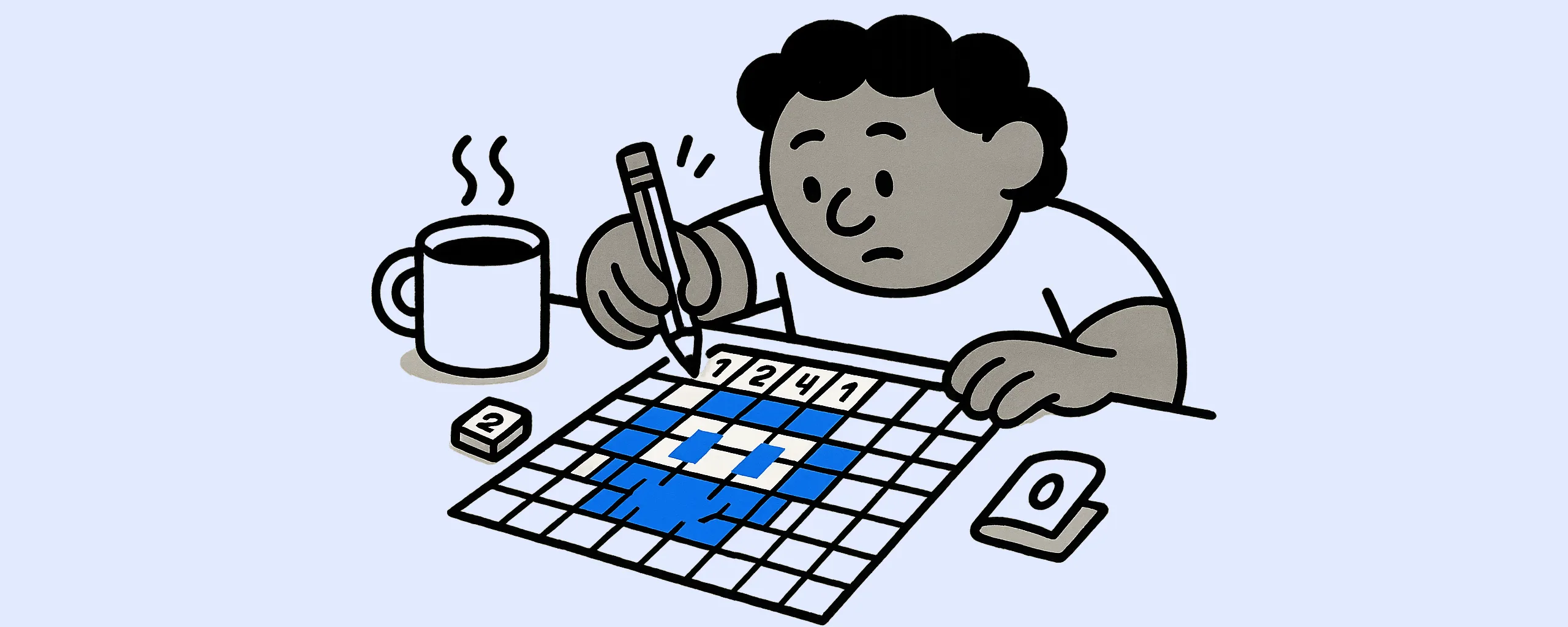
There is a particular pleasure in a puzzle that hides nothing from you and still makes you earn the answer. Umbra hands you a grid, a scattering of clues that are already coloured, and two colours to work with. By the end every cell is either light or shadow, the board has broken cleanly into fields, and not one field touches another of its own colour.
Umbra is our daily light and shadow puzzle, and the natural next stop if you have been hunting for games like Fillomino or Nurikabe. It is a numbered region puzzle: the grid gets divided into blocks whose sizes are written inside them. What Umbra changes is how those blocks are kept apart.
How Umbra works
Every board opens with a handful of clues that arrive already coloured, some light and some shadow, each carrying a number. Those are givens. You cannot recolour them, and that turns out to matter more than it looks. Everything else starts blank, and you fill it in by deciding, cell by cell, which of the two colours it takes.
A field is simply a run of touching cells that share one colour. Three rules govern them:
- Every cell ends up coloured. Nothing is left blank at the finish.
- Every field holds exactly one clue, and covers exactly as many cells as that clue says.
- Two fields of the same colour may never share an edge. Corners do not count as touching, and a lot of the better deductions live in that gap.
Tap a blank cell to cycle it light, then shadow, then blank again, or drag to paint a run in one pass.
What separates Umbra from games like Fillomino
The coloured clues are not decoration. They are the reason each board has a single answer.
The rules only ever say which cells belong to a field. They never say which colour a field should be. So a board of bare numbers would always have two correct answers, the one you found and its exact mirror image, with every light field turned dark and every dark one light. Colouring the clues settles it. That is the whole job those colours are doing, and it is why you are not allowed to change them.
The question marks
From Wednesday onward, some clues arrive as a question mark instead of a number. A question mark is a given like any other, a real field of a real colour, except its size is not written down. You prove it from everything packed around it.
Three things pin it. Every cell belongs to exactly one field, so all the field sizes add up to the number of cells on the board. Subtract the numbers you can see and you know exactly how many cells the hidden fields share between them. Fields tile the grid with no gaps. And no field is ever larger than six cells, which is a published rule precisely so a question mark is never open ended.
On a Wednesday there is one of them. By Sunday there are five.
Scoring and the week
The board grows through the week, a 5x5 warm up on Monday climbing to a 9x9 on Sunday, and the question marks grow with it. Monday and Tuesday have none at all, so a first board shows you every size written down.
There is no way to lose and no move limit, so how fast you finish is the whole result. A solve banks base points, then a speed tier, a flawless bonus for never breaking a rule on the board, a difficulty bonus that scales with the day, and a streak alongside.
Two things help without giving anything away. A number quietly fades once its field is exactly the size it asks for, which is the board keeping count for you. And an optional setting will highlight a field that has already gone wrong, if you want the safety net. It never points at the answer, only at a rule you have already broken.
One tip
Start with the ones. A clue of 1 is a field that is finished the moment you see it, and it gives you more than that: every cell touching it must take the other colour, because a same coloured neighbour would grow it to two. One clue, five certainties, and the rest of the board opens from there.
Umbra is live now.