What kind of puzzler are you?
- If you like word games — Wordle, Dordle, Minute Cryptic, Raddle, Squaredle, Strands, and SlideWord
- If you like logic & deduction puzzles — Clues by Sam, Daily Akari, Stars & Fields, Connections, Nerdle, Murdle, and Shrooms
- If you like trivia & knowledge puzzles — Worldle and Cinematrix
- If you want something you won't find anywhere else — Angler and Chroma
If you like word games
Letters, ladders, grids, and cryptic clues — for players who think the right word is its own reward.
Best for: Everyone. The one that started the craze.
You know this one, so we will keep it short. Five-letter mystery word, six guesses, green-yellow-gray feedback after every try, one fresh puzzle a day. Wordle is the benchmark every game on this list is measured against, and the reason the whole puzzle-of-the-day format exploded. If you have somehow never played, start here — then come back, because the rest of the list assumes you already have the daily habit.
Play Wordle →
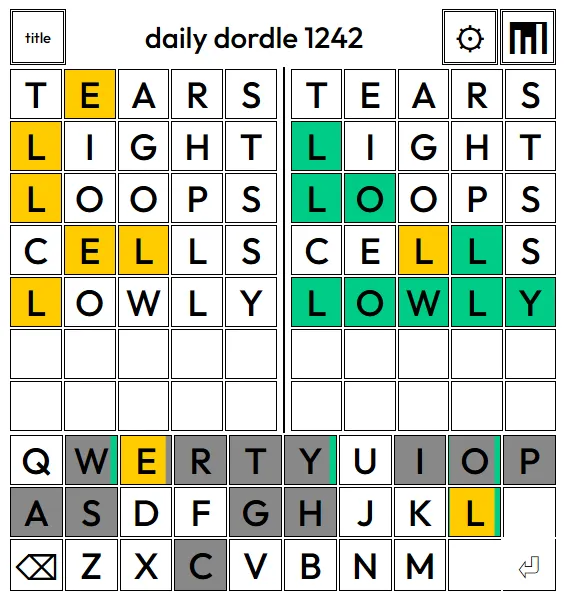
Best for: Wordle fans who want more challenge without changing the format.
Dordle is Wordle doubled. You solve two secret words at the same time, on two grids, and every guess you type applies to both boards simultaneously. That single twist changes the whole calculus: do you nail down the left word first and risk burning guesses, or hunt for letters that narrow both at once?
It looks familiar enough that there is no learning curve, but the strategy runs deeper than the original. It is the perfect next step the day a single five-letter word stops feeling like enough.
Play Dordle →
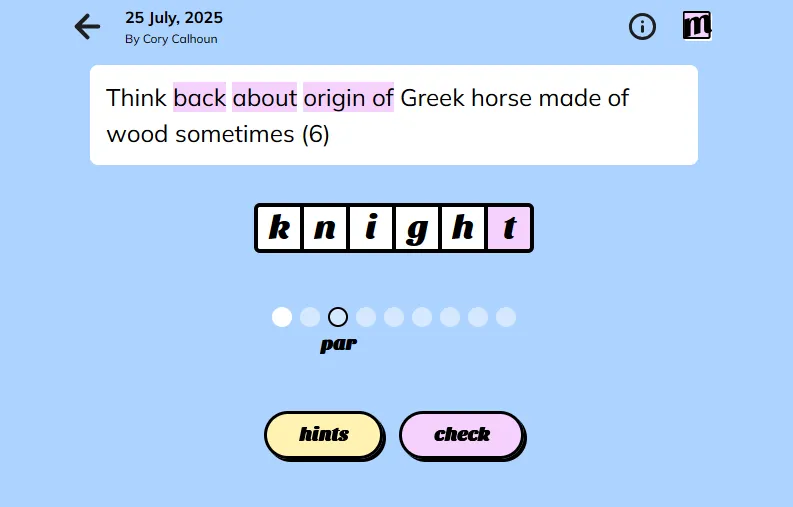
Best for: Word nerds who want something genuinely different from letter-guessing.
Cryptic crosswords scare a lot of people off, and Minute Cryptic exists to fix that. Each day it gives you exactly one cryptic clue to crack. The trick to cryptics is that every clue has two halves working at once: one is a straight definition of the answer, the other is a set of wordplay instructions — an anagram, a hidden word, a pun — that builds the same answer a different way.
Minute Cryptic layers in optional hints that peel the clue apart step by step, so it doubles as the gentlest cryptic tutorial on the web. UK crossword die-hards will love it; total beginners can finally learn the form without buying a book.
Play Minute Cryptic →
Best for: Language lovers who enjoy wordplay and lateral thinking.
Raddle hands you a starting word and an ending word, and your job is to travel between them through a ladder of small transformations — change a letter, add one, rearrange. The catch that makes it sing: the clues for each rung are presented out of order. Figuring out which transformation applies next is as much of the puzzle as solving any single step.
It rewards the kind of brain that enjoys turning a word over in its hands. If you finished a word guessing game and wished the words actually moved, this is your daily.
Play Raddle →
Best for: People who liked Spelling Bee but want a grid format.
Squaredle drops you onto a grid of letters and asks you to find as many connected words as you can, Boggle-style. Each daily puzzle hides a required bonus word that ties everything together, so there is a clear win condition on top of the open-ended hunt for extra finds.
It scratches the same completionist itch as Spelling Bee — there is always one more word in there somewhere — but the grid layout and pathfinding give it a distinct rhythm. Great for the player who likes a puzzle they can dip back into across the day.
Play Squaredle →
Best for: Spelling Bee and word-search fans.
Strands is the Times' themed word-search hybrid, and it is the bridge between word games and lateral-thinking puzzles. Every word in the grid connects to a single daily theme, and hidden among them is a spangram — one long answer that stretches all the way across the board and sums up the day's idea.
The pleasure is in the dawning realization of what the theme actually is; once it clicks, the remaining words tumble out fast. If you already have it in your NYT rotation, treat it as the on-ramp to the weirder grids further down this list.
Play Strands →
Best for: Word lovers who want to solve with their hands, not the keyboard. (Yes, this one is ours.)
SlideWord is the word game we built for people who like to rearrange. You get a scrambled 5×5 grid and slide whole rows and columns — letters wrapping around the edges — until five hidden words line up across the rows. You never type a guess. The whole puzzle is an order-of-operations problem: lock one word into place without scrambling the next.
Easy mode lets you freeze finished rows so they hold still while you work the rest; Hard mode strips the locks away and makes all five words land at the same instant. It is timed, but gently — the clock pauses the moment you step away, and there is no move limit, so a messy path never costs you. Clues sit under the board for when a word will not come.
Play SlideWord →
If you like logic & deduction puzzles
Grids, deductions, and quiet "aha" moments — for players who want to reason their way to the answer.
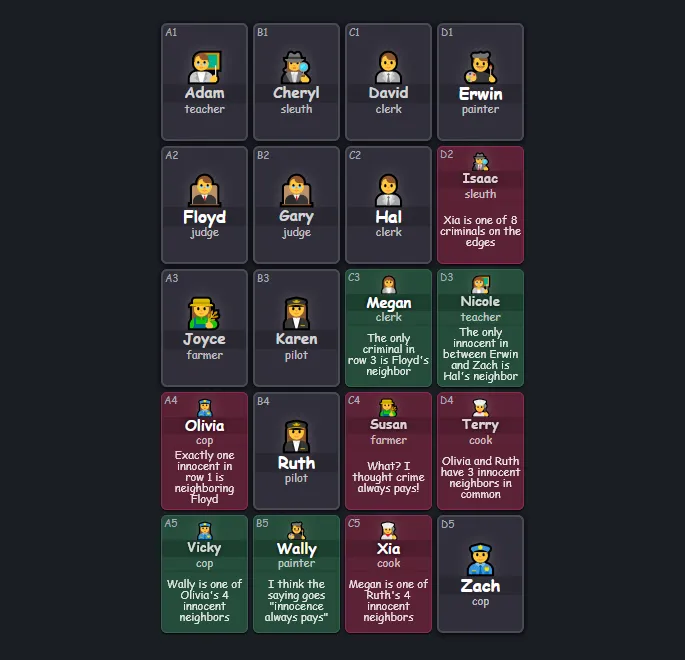
Best for: Mystery fans, logic-puzzle lovers, anyone who likes Connections but wants a story.
Clues by Sam is a daily whodunnit built on a grid of townspeople, some of whom are criminals. Each resident gossips about their neighbors — but here is the hook — a person only shares their tip after you have correctly marked them as innocent or guilty. So every correct deduction unlocks the next clue, and the puzzle becomes a domino chain of reasoning.
That structure makes it feel less like a logic grid and more like interrogating a small, suspicious town one face at a time. Narrative and deduction in one tidy daily package.
Play Clues by Sam →
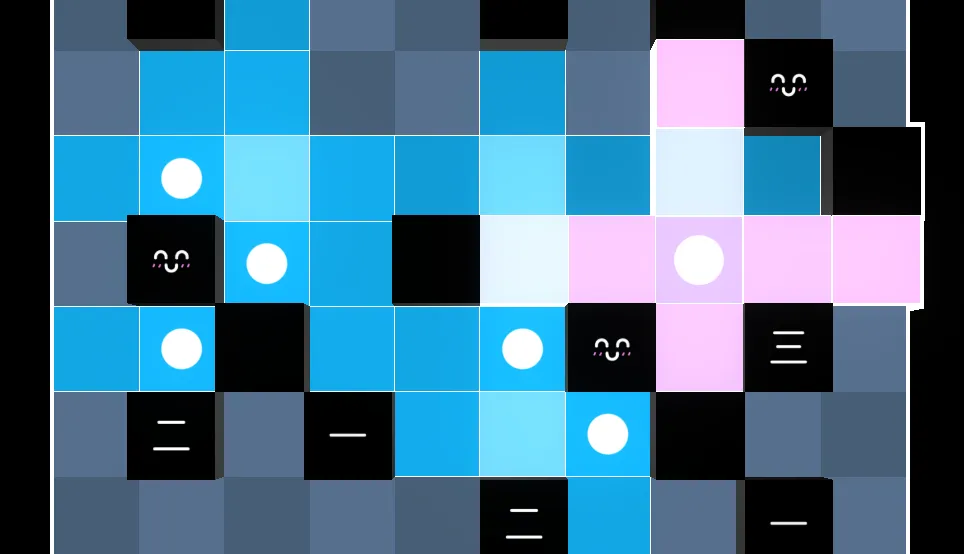
Best for: Sudoku fans and logic-puzzle regulars.
Akari (also called Light Up) is a Japanese logic puzzle, and this daily version is the cleanest way to play it. You place light bulbs on a grid so that every cell is illuminated, with two rules: no two bulbs can shine directly on each other, and numbered walls tell you exactly how many bulbs must surround them.
It is pure deduction with a satisfying physical metaphor — you can see the room light up as you solve. Cheerful animations and a clean interface make it a lovely, low-stress alternative if you have worn a groove in your Sudoku or Picross habit.
Play Daily Akari →
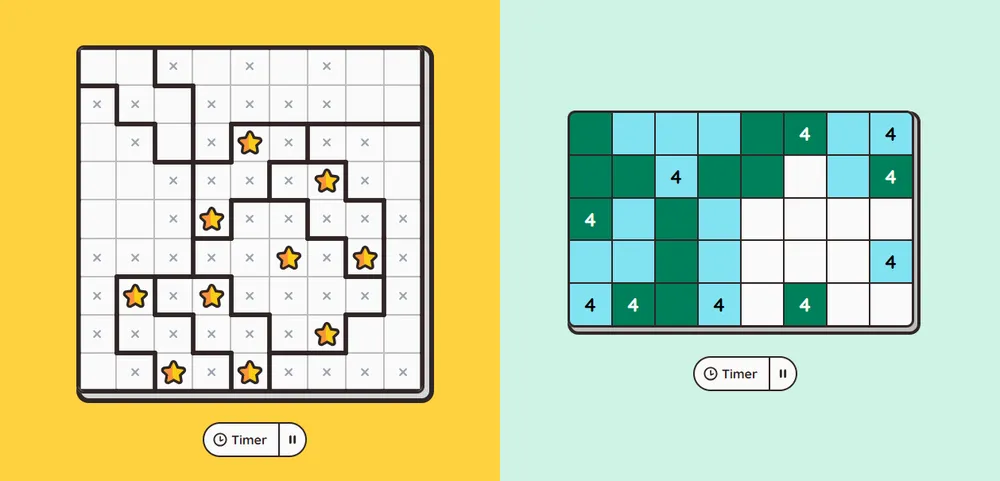
Best for: Paper-puzzle fans (Star Battle, Nurikabe) coming to the web.
Inkwell makes a pair of daily logic puzzles with the kind of clean, minimal design that paper-puzzle people adore. In Stars, you place stars so that every row, column, and bordered region contains exactly two — none touching. In Fields, you color the whole grid with two colors that can never touch their own kind across a border.
Both refresh daily and ramp in difficulty through the week, so Monday eases you in and the weekend bites. If your shelf holds a battered Star Battle or Nurikabe book, this is that experience, online and free.
Play Stars & Fields →
Best for: Trivia fans, lateral thinkers, people who like categories.
Connections gives you sixteen words and asks you to sort them into four groups of four. Each group shares a hidden category, color-coded by difficulty from easy yellow to fiendish purple. The whole game lives in the overlap: half the words look like they could slot into two or three groups at once, and the puzzle is engineered to punish your first instinct.
It is the rare daily that is equal parts vocabulary and trickery, which is why it has become the second tab everyone opens after Wordle. Four mistakes and you are out — choose your first group carefully.
Play Connections →
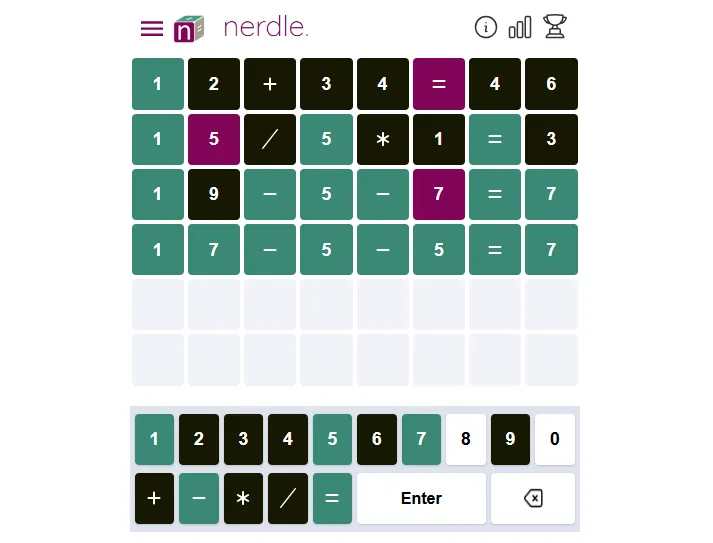
Best for: Math-minded players, engineers, anyone who found Wordle too word-y.
Nerdle takes the Wordle template and replaces letters with numbers and operators. You have six guesses to crack a hidden equation, and every guess you submit has to be a valid equation in its own right — the digits, the operators, and an equals sign all have to balance. Colored tiles tell you which pieces are in the right spot.
It rewards thinking in numbers the way Wordle rewards thinking in letters, and the constraint that your guesses must compute keeps you honest. A daily must for anyone who always wished the green-tile feedback loop came with arithmetic.
Play Nerdle →
Best for: Fans of Clue, logic grids, and murder mysteries.
Murdle is a daily murder mystery wrapped around a classic logic grid. Each puzzle gives you a cast of suspects, a set of weapons, and a list of locations, plus a stack of deductive clues. Cross-reference your way through them — if the detective was not in the library, and the candlestick belongs to the duchess — until exactly one suspect, weapon, and place survive.
What sets it apart is the personality: hard-boiled noir framing, escalating difficulty levels, and a genuine sense of cracking a case rather than filling a chart. If you grew up loving Clue, this is the daily version of that feeling.
Play Murdle →
Best for: Star Battle fans and anyone who likes a cozy board that fights back. (Another of ours.)
If the Stars puzzle above hooked you, Shrooms is our take on the same deduction, with a forest skin and a few sharper teeth. You get a grid split into colored regions and one rule to obey everywhere: forage exactly two mushrooms in every row, every column, and every region — and no two mushrooms may touch, not even on a diagonal.
That no-touching rule is what turns it into a real chain of logic. Place one mushroom and the eight squares around it are instantly ruled out, so the board keeps folding in on itself until the answer is forced. Every puzzle has a single guaranteed solution, so you never guess; a misplaced cap simply turns red so the mistake jumps out. It ships in three timed sizes daily — 8×8, 10×10, and a 12×12 that genuinely bites.
Play Shrooms →
If you like trivia & knowledge puzzles
For players whose best weapon is what they already know — geography, movies, and the deep cuts.
Best for: Map nerds, geography buffs, travelers.
Worldle shows you the silhouette of a single country and asks you to name it. Guess wrong and it tells you how far off you are and in which direction — say, 3,200 km to the northeast — so each attempt narrows the globe like a game of hot-and-cold played across continents.
It is deceptively hard once you leave the countries everyone can draw from memory, and weirdly addictive in the way it rebuilds your mental map of the world one outline at a time. Geography obsessives, this is your daily home.
Play Worldle →
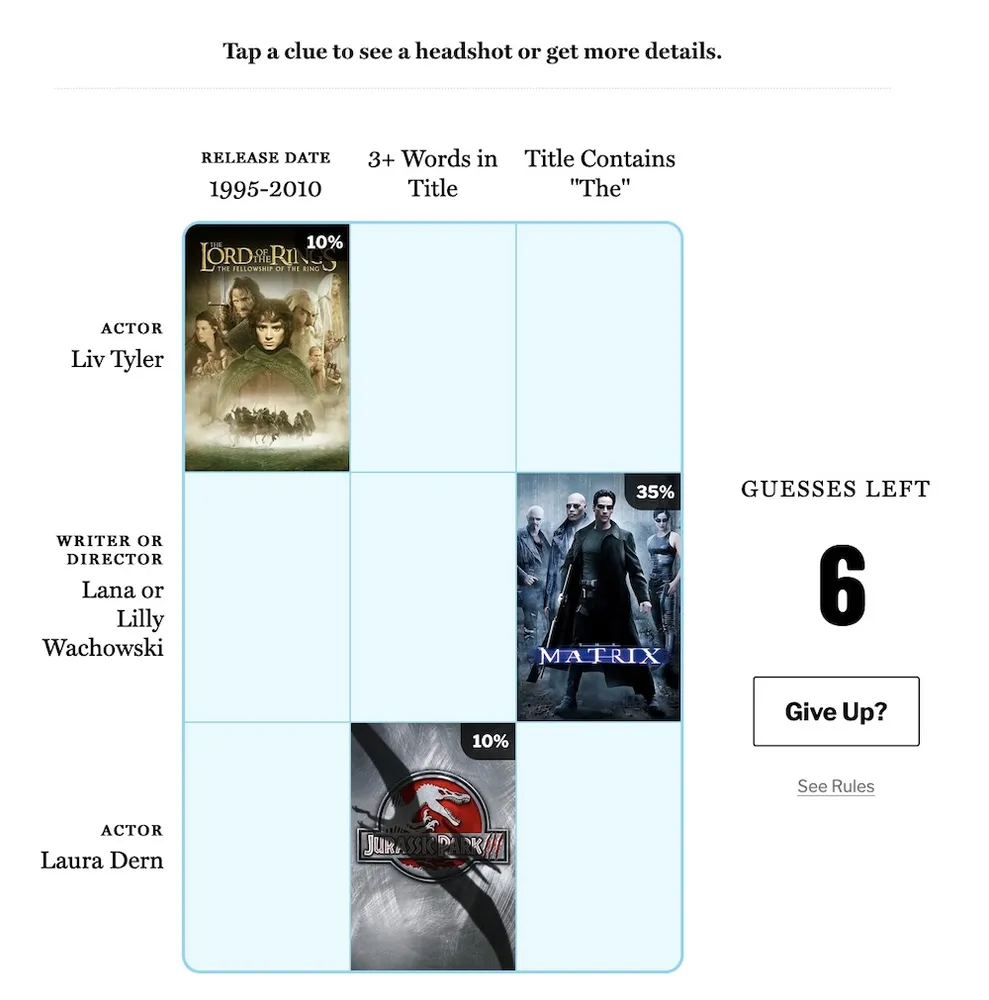
Best for: Movie buffs and pop-culture trivia fans.
Cinematrix, from Vulture, is a 3×3 grid where the rows and columns each carry a criterion — a Nicole Kidman film crossing won an Oscar, or one-word title crossing released in the '90s. Your job is to name a movie that satisfies both for each of the nine squares.
The strategy comes from scarcity: plenty of movies might fit a given square, but the obvious answers get used up fast, and a rarer title in the wrong cell can box you out later. It is trivia with a placement puzzle layered on top — perfect for the friend who always wins movie night.
Play Cinematrix →
If you want something you won't find anywhere else
Two daily games of our own that do not slot neatly into word, logic, or trivia — because they are not about what you know. They are about what you can see.
Best for: Players who trust their eyes and want a puzzle nobody can study for.
Angler shows you a single angle and gives you four guesses to name how many degrees it is. That is the whole game. There is no vocabulary, no trivia, no grid — just a shape on the screen and the quiet question of whether that opening is closer to 40 degrees or 55. Each wrong guess tells you whether you are too high or too low and how warm you are getting, and you narrow in.
What makes it special is that it rewards perception instead of knowledge. Everyone sees the same angle; no obscure word gives crossword veterans an edge. A ten-year-old and a geometry teacher look at the exact same shape. It is the most level playing field on this list, and it will quietly change how you look at every door frame and roofline you pass.
Play Angler →
Best for: Anyone who reads color for a living, or just wishes they did.
Chroma is a daily color puzzle where the answer does not arrive through calculation — it snaps into focus all at once, the way a hidden image resolves out of a stereogram. You tune and compare until the colors line up the way the puzzle intends. It sits in a lovely sweet spot between objective and intuitive: there is a single correct answer, but you reach it by feel, trusting the same instinct that tells you when two socks do not quite match.
Like Angler, you cannot study for it. You show up each day with the only tool you need — your own eyes — and find out how sharp they are. It is quick, calming, and over weeks it genuinely trains your eye to catch color relationships everywhere.
Play Chroma →
Build your daily five
The whole appeal of a daily puzzle is the ritual — a small, finite, winnable thing that bookends your morning. So do not just play one. Bookmark three or four of these, line them up after your Wordle, and let them become muscle memory. The mix is the point: a word ladder to warm up, a logic grid to dig in, a perception game to stretch your brain in a different direction.
And keep an eye out, because new daily games launch all the time — the format is having a genuine renaissance, and the best brain training games of next year probably have not shipped yet. Pick a couple of free ones today, and you will have a daily puzzle game habit that outlasts any single trend.
Want to go deeper on one lane? We have a full rundown of Wordle alternatives for the word crowd and a guide to the best daily logic puzzles for the deduction lovers. Which of these is your new daily habit? Let us know in the comments.